
Series 6 | The Expanding Boundary: The Tower, the Boat, and the Silicon Amoeba
Subtitle: From ExO to MVO: When Agents Rewrite Organizational Boundaries, How PD Holds the Human Position as Owner

Prologue: The Boundary of Intelligent Systems Is Expanding Outward
In this series, we have traveled a long and dark journey.
In Episode I, I discussed the "Helmsman Crisis" after the commoditization of execution power.
When AI Agents' execution capabilities become increasingly cheap, what becomes truly scarce for humans is no longer the ability to personally complete every action, but the ability to judge direction, define goals, and bear consequences.
In Episode II, I recorded the failure of the Prompt Injection experiment.
Writing a few principles into prompts cannot truly give Agents wisdom. If principles have not passed through concrete situations, painful feedback, and action calibration, they easily become silicon chicken soup.
In Episode III, I proposed the Pain Signal.
Principles are not instilled; they grow out of real failures, repeated corrections, and painful reflection. A system that cannot see Pain cannot truly learn.
In Episode IV, I discussed the alchemy of soft-to-hard transformation.
Those repeatedly verified bottom lines cannot remain forever in Prompts. They should be compiled into Skills, RuleHosts, or deeper system instincts.
In Episode V, I pulled the perspective back from the Agent to the Owner.
What PD truly focuses on is not an isolated Agent, but the Owner-Agent synthesis. The Agent expands execution bandwidth, PD precipitates pain, principles, and feedback, and the Owner provides long-term value judgment, meaning anchors, and final sovereignty.
Writing to this point, PD's interim thinking seems to have formed a closed loop:
Flood of execution power
→ Prompt Injection failure
→ Pain Signal
→ Soft-to-hard transformation
→ Owner-Agent co-evolution
But if we push the view one layer further outward, a larger question emerges:
When the boundary of intelligent systems keeps expanding outward, which old containers in human society will be rewritten?
At first, we thought AI's boundary was text.
It could chat, write copy, summarize materials.
Later, we found it could write code.
Still later, it could read repositories, call tools, execute commands, manage context, complete migrations, and handle long-horizon tasks.
Now, Agents are connecting to file systems, browsers, databases, payment interfaces, enterprise processes, robots, organizational memory, and real-world actuators.
This means it is no longer just a software feature.
It is starting to become a new social execution layer.
The boundary of intelligent systems is expanding from text to action, from action to collaboration, from collaboration to organization, from organization to governance, and even to the production of meaning.
This sounds grand.
But its early version has already appeared before everyone who heavily uses Agents.
Imagine a very ordinary evening.
An independent developer opens his computer, ready to continue advancing his product. He is no longer working alone.
One Agent is helping him modify the frontend.
One Agent is organizing user feedback.
One Agent is refactoring the backend module.
One Agent is writing release copy.
Another Agent is searching for competitors and technical solutions.
On the surface, he has the productivity that only a small team had in the past.
But half an hour later, problems begin to appear.
The frontend Agent suggests redoing the component system.
The backend Agent finds the database structure inelegant and suggests migrating it along the way.
The user feedback Agent reminds him that there are 17 potential requirements worth analyzing.
The copy Agent generated 5 positioning directions, but each deviates from what he truly wants to express.
The competitive analysis Agent lists a long string of "must-fill" features.
Each item seems reasonable.
Each item seems to be helping him.
But each item is demanding judgment from him.
He suddenly realizes that he has not become more relaxed.
He has only gone from "the person who does things personally" to "the person who constantly approves, corrects, adjudicates, and bears consequences."
This is the truest paradox of the strong Agent era:
Execution power has been amplified, but human attention has not been amplified. Possibilities have been amplified, but human trade-off ability has not been automatically amplified.
Every expansion of the intelligent boundary swallows part of the old order.
It also exposes a deeper human bottleneck.
When AI can write text, we begin to ask: do humans still need writers?
When AI can write code, we begin to ask: do humans still need programmers?
When AI can call tools, we begin to ask: do humans still need operators?
When AI can manage tasks, we begin to ask: do humans still need middle management?
When AI can organize Agent swarms, we begin to ask: do humans still need traditional companies?
If one day in the future, AI can interpret scriptures, comfort believers, dispatch robots, manage cities, participate in scientific research, design molecules, control infrastructure, and influence markets and public opinion, we will continue to ask:
What cannot be outsourced?
What must be borne by humans?
What needs to be protected?
What is the human position in a strong intelligent system that remains inalienable?
This article is not meant to give the final answer to these questions.
It is more like a boundary observation.
I want to follow the continuously expanding boundary of intelligent systems, looking from companies, organizations, society, states, religions, and meaning — these larger containers — and then return to PD.
Because PD is not a world government, not a super platform, and not trying to create some omniscient and omnipotent "god."
PD only cuts in from a very small place:
As Agents become stronger, how does the Owner preserve their goals, boundaries, responsibilities, attention, and final adjudication power?
Perhaps this is the value that PD might exist for.
Not to become the giant wave.
But in the giant wave, to become a light small boat.
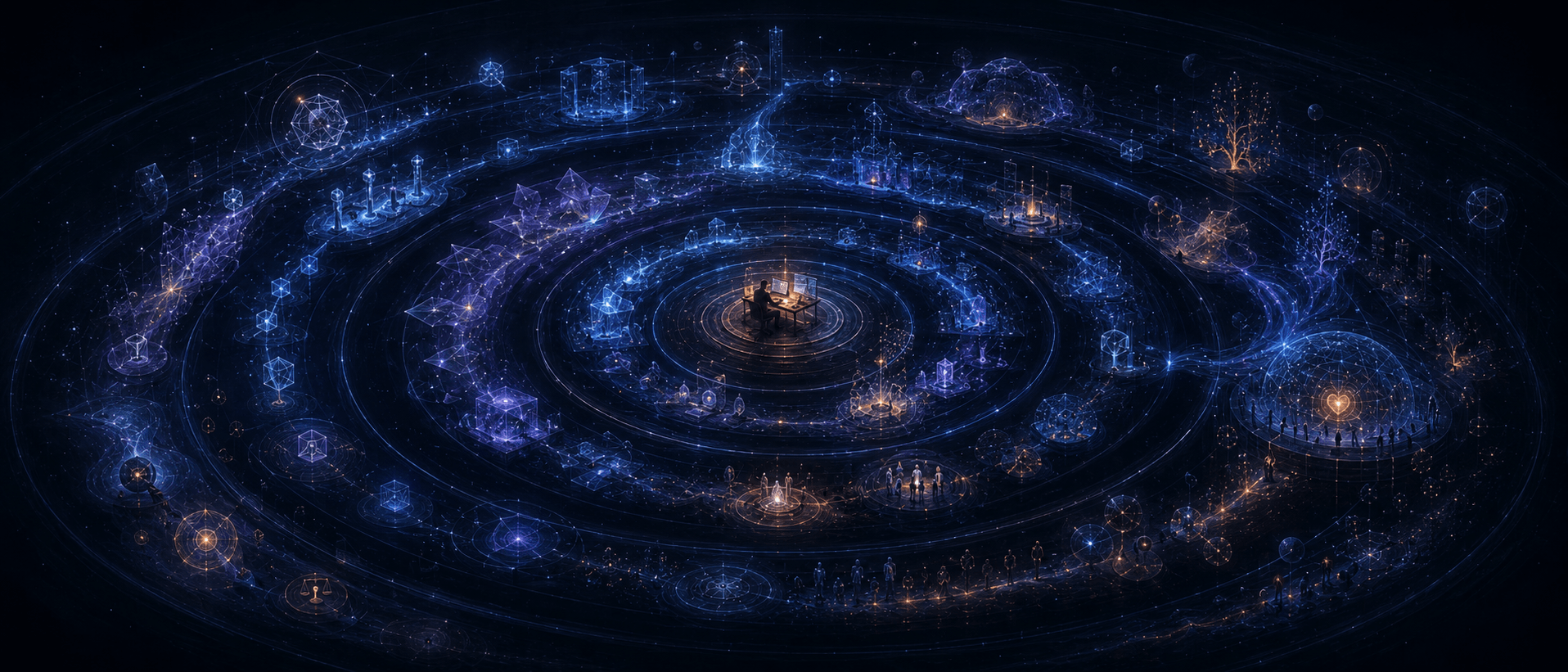
01 From ExO to Agent-native: Why Will Company Boundaries Be Repriced?
Before discussing future organizations, we must first return to an old question:
Why do companies exist?
Most people take companies as the natural background of modern society.
Employment, reporting, hierarchy, approval, departments, budgets, KPIs, performance, meetings, org charts.
These things are so common that we often forget: companies are not natural laws that have existed since ancient times, but an organizational technology of a certain historical stage.
To understand company boundaries, we must return to Ronald Coase.
Coase posed a classic question in "The Nature of the Firm":
Since the market mechanism is so efficient, why do firms need to exist?
If everyone can trade directly in the market, why not outsource every task, rather than locking a group of people into an organization called a "company" and coordinating them through administrative orders?
Coase's answer was: transaction costs.
In a pure market, you need to find the right person — this is discovery cost.
You need to negotiate price, scope, and delivery standards — this is negotiation cost.
You need to monitor whether the other party fulfills the contract — this is supervision cost.
You need to handle breaches, disputes, and conflicts — this is enforcement and arbitration cost.
When these external transaction costs are too high, employing people inside a company and replacing market transactions with hierarchy, process, and administrative orders becomes cheaper.
So, a company can be seen as an organizational fortress against high transaction costs.
But now, Agents are changing this premise.
Not reducing all transaction costs to zero.
That would be too idealistic.
More accurately, Agents will compress certain low-level transaction costs by several orders of magnitude:
Discovery cost decreases
Communication cost decreases
Documentation cost decreases
Execution cost decreases
Initial verification cost decreases
Synchronization cost decreases
Simple settlement cost decreases
An Agent can search candidate solutions, generate contract drafts, read API docs, call tools, verify results, record processes, and generate reports in a very short time.
A small team can leverage external APIs, cloud services, model capabilities, open-source components, automated testing, freelancers, and Agent workflows to accomplish what previously required an entire department.
This will cause traditional company boundaries to be repriced.
What had to be inside the company in the past may become externally callable capability in the future.
What required fixed teams for long-term coordination in the past may become temporary Agent networks in the future.
What required large amounts of middle-layer coordination in the past may be taken over by protocols, interfaces, dashboards, and automated workflows.
This reminds me of the ExO framework proposed in "Exponential Organizations."
The core idea of ExO is: in an era of rapid technological development, an organization's success no longer depends on how many assets and employees it owns, but on whether it can achieve 10x-level growth through massive transformative purpose, external resource leverage, algorithms, interfaces, experimentation, and autonomy.
In the mobile internet era, ExO discussed how to leverage external resources:
Staff on Demand
Community & Crowd
Algorithms
Leveraged Assets
Engagement
And how to absorb these external resources through internal mechanisms:
Interfaces
Dashboards
Experimentation
Autonomy
Social Technologies
But in the Agent era, these concepts will be reinterpreted.
Staff on Demand → Agent on Demand
Community & Crowd → Human-Agent Swarm
Algorithms → Agentic Reasoning
Leveraged Assets → Model / Compute / API / Data Leverage
Interfaces → Agent Protocols
Dashboards → Governance Cockpit
Experimentation → Autonomous Experiment Loops
Autonomy → Human-supervised Agent Autonomy
ExO 1.0 discussed how organizations leverage external abundant resources.
Agent-native Organization discusses how organizations leverage external abundant intelligence.
This is a deeper change.
Because past external resources still required massive human coordination.
But external resources in the Agent era themselves carry execution, understanding, generation, scheduling, and feedback capabilities.
So, organizations will no longer primarily revolve around human allocation, but increasingly around intelligence allocation.
But this does not mean companies will simply disappear.
Companies will still bear legal responsibility, capital aggregation, brand trust, compliance subject, long-term commitment, risk isolation, and social credit interface.
Agents will reduce many execution and coordination costs, but will not automatically eliminate higher-order governance costs like responsibility, trust, legitimacy, and long-term commitment.
In fact, quite the opposite.
The more execution is handed to Agents, the more someone needs to answer:
Who set the goals?
Who is responsible for the results?
Who bears the risk?
Who corrects the errors?
Who should the external world trust?
So, companies will become thinner.
They will gradually shift from "containers that employ large numbers of human executors" to "containers that carry goals, responsibility, trust, capital, compliance, and long-term governance."
Traditional company boundaries are being rewritten, not because companies have no value.
But because intelligent systems let us see again:
The truly irreplaceable part of a company is not human stacking, but responsibility, trust, and long-term commitment.
This also explains why PD cares not just about whether an Agent can execute tasks.
When organizational boundaries thin, when a small team can leverage Agents to gain the execution power of large companies, it needs a lightweight governance kernel to help it handle goals, responsibility, boundaries, feedback, and attention.
This is exactly the position PD is trying to enter.
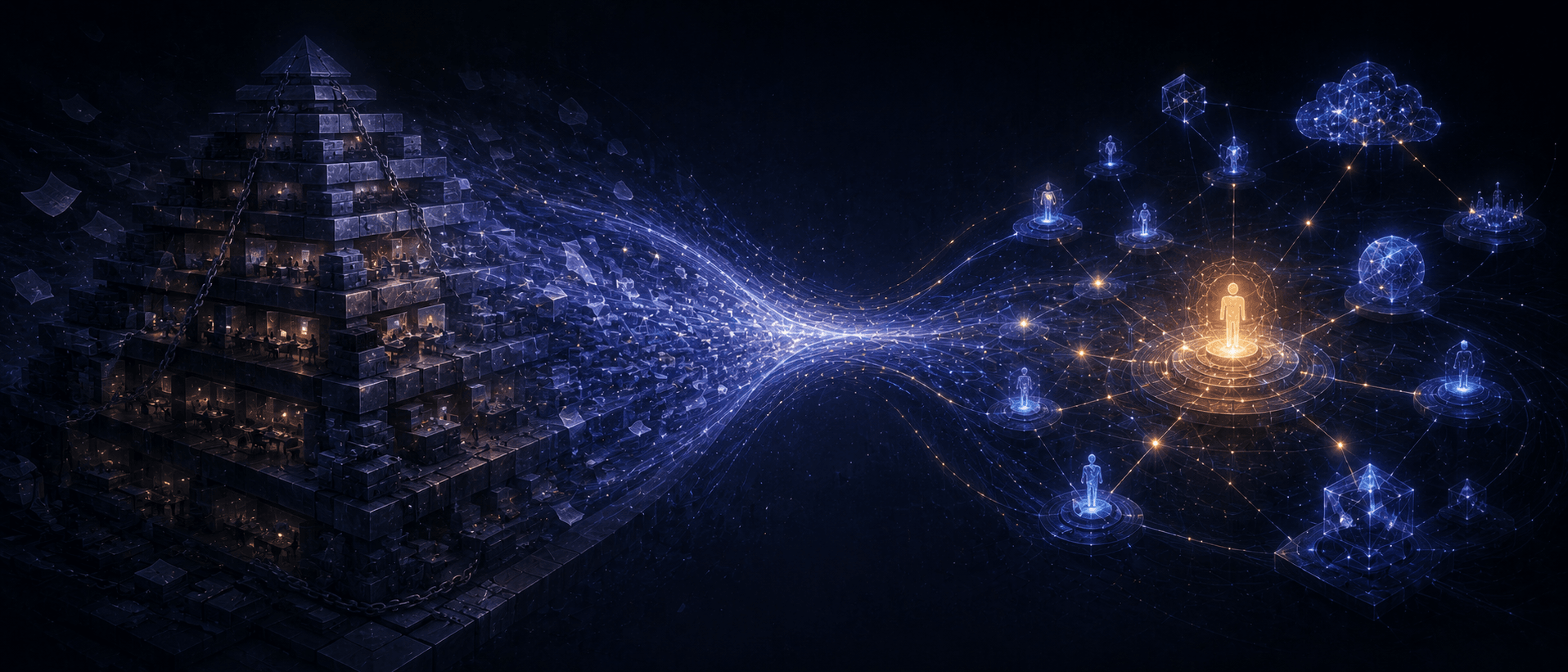
02 The Inverted-T Organization: After the Middle Layer Disappears, Owners Will Be Drowned by Intelligent Swarms
If company boundaries are being repriced, then what will be hit first inside the company?
Most likely middle management.
But here we must be careful.
What AI compresses is not the "middle manager" position itself.
What AI compresses is the set of functions that middle management has long borne.
In traditional carbon-based organizations, the core value of middle managers is not just issuing orders.
Their more important role is as information denoisers and attention filters.
Frontline programmers, operations, sales, customer service, and designers encounter countless concrete problems every day:
Server anomalies
Requirement ambiguity
Customer complaints
Component conflicts
Permission issues
Deployment incidents
Budget constraints
Cross-department disputes
Execution priority conflicts
Middle management absorbs this chaos, digests large amounts of noise locally, and only compresses, clusters, and ranks the problems that truly need higher-level handling before passing them to top decision-makers.
They use their time, experience, and contextual understanding to protect the extremely scarce attention bandwidth of top Owners.
This does not mean traditional middle management has no inefficiency, bureaucracy, or politics.
It certainly does.
But if we only see middle management's inefficiency and ignore its information filtering function, we make a dangerous mistake:
Believing that after cutting middle management, the organization will naturally become flat and efficient.
The reality may be exactly the opposite.
When companies, in pursuit of AI efficiency, frantically compress the "inefficient" middle layer, the organization may collapse into an inverted-T structure:
Top: a few human Owners
Bottom: massive AI Agents
Middle: filter layer disappears
On the surface, this is extreme cost reduction and efficiency gain.
A few Owners command massive Agents.
No hierarchy.
No reporting.
No office politics.
No human inefficient communication.
But from a system dynamics perspective, this could be a disaster.
Because what you thought was cutting dead weight may actually be removing the firewall.
When the middle filter layer disappears, the boundary conflicts, risk judgments, anomalies, goal ambiguity, and value conflicts encountered by massive Agents during execution will directly hit top Owners like a tsunami.
A human Owner handling 10 high-quality decisions per day can think deeply.
Handling 100 decisions per day begins to fatigue.
Handling 1,000 decisions per day enters cognitive overload.
Facing 100,000 micro-anomalies, rule conflicts, and approval requests generated by Agents per day, he cannot possibly remain sober.
He will start blindly clicking "agree."
Or simply delegate adjudication entirely to the system.
So, humans are nominally still in the loop.
In reality, they have been swallowed by the system.
This is not a distant sci-fi scenario.
Many heavy AI users today have already experienced its early version.
You let an Agent help you write code, and it quickly gives you 5 solutions.
You let an Agent help you modify the product, and it generates 12 improvement points.
You let an Agent help you with operations, and it lists 30 growth experiments.
You let an Agent help you analyze user feedback, and it summarizes 50 requirement opportunities.
Each item seems reasonable.
But each item is demanding judgment from you.
In the end, what truly drags you down is not that the Agent isn't smart enough, but that it generates too many possibilities without the ability to bear trade-offs for you.
This is the danger of the inverted-T organization:
A few Owners
+ massive Agents
- middle filter layer
= cognitive tsunami
Execution power becoming infinitely cheap does not reduce the cost of decision errors.
On the contrary, it lets a tiny decision error be amplified into large-scale consequences in a very short time.
A human employee misunderstanding a goal may just do one thing wrong.
A group of Agents misunderstanding a goal may modify hundreds of files, send thousands of emails, generate a pile of wrong strategies, and trigger a series of cascading operations within ten minutes.
The stronger the intelligent system, the less human attention can be wasted.
This is also why in Episode V I repeatedly emphasized:
The Owner should not become the system's customer service. The Owner should become the system's supreme court.
The truly important middle layer of the future may not necessarily be human.
It may be protocols.
It may be dashboards.
It may be exception escalation systems.
It may be Pain Evidence clusterers.
It may be RuleHosts.
It may be attention protection layers.
Middle management will not disappear.
It will migrate from human hierarchy to system structure.
The attention protection layer is a way of reinventing middle management for the AI era.
And what PD wants to explore is exactly a small prototype of this new middle layer.

03 MVO: The New Economic Atom of the Intelligent Era
If the boundaries of traditional heavy companies are thinning, and the inverted-T organization brings cognitive disaster, then what will the new organizational atom be?
I increasingly lean toward describing it with one concept:
MVO: Minimum Viable Organization.
It is not a romantic way of saying "one-person company."
Nor is it a hype version of the "super individual."
MVO is a minimum economic unit composed of a human Owner and an intelligent system together.
It is small enough to stay agile.
It is complete enough to independently sense opportunities, set goals, dispatch Agents, deliver results, bear responsibility, accumulate experience, and continuously evolve through feedback.
A true MVO contains at least seven parts:
Owner: goals, value function, responsibility bearer
Agent Pool: execution, exploration, analysis, generation
Memory: long-term context and organizational memory
Principle Ledger: principle ledger
RuleHost: hard boundaries and risk control
Attention Layer: filters noise, protects Owner attention
External Interfaces: connects external people, tools, markets, and platform resources
This structure has a distant resonance with Inamori Kazuo's "Amoeba Management."
Amoeba Management tries to split large enterprises into small teams, letting each team independently account and bear its own profits and losses, thereby stimulating organizational vitality.
This idea has vitality.
But it is difficult to implement in many organizations.
The reason is not complicated:
Internal transaction costs between humans are too high.
When Amoeba A needs Amoeba B's cooperation, it still needs meetings, negotiations, KPI alignment, internal pricing, blame-shifting, resource competition, and office politics.
The vitality brought by small units is often offset by friction between small units.
But if we put amoebas into the Agent era, the situation changes.
Inside an MVO, much collaboration no longer requires inefficient human communication.
Agents can automatically sync context.
Agents can generate plans.
Agents can call tools.
Agents can record processes.
Agents can verify each other.
Agents can explore in parallel within boundaries set by the Owner.
This means a very small human team, or even a sufficiently sober Owner, can leverage an Agent Pool, external APIs, model capabilities, and automated processes to gain the productivity that previously required a department or even a small company.
This is the true meaning of the "silicon amoeba."
It is not pure silicon life.
Nor is it a pure human team.
It is a carbon-silicon symbiont:
Humans provide goals, values, boundaries, responsibility, and meaning
Agents provide execution, search, generation, analysis, and feedback
PD provides principles, memory, boundaries, audit, and attention protection
For example, a person who has done operations for ten years.
In the past, his value was reflected in writing daily reports, pulling spreadsheets, chasing data, scheduling events, coordinating channels, rushing designs, and revising copy.
Today, these actions are being rapidly swallowed by Agents.
If he only understands himself as "a person who can make spreadsheets, write copy, and schedule," then his value will indeed be compressed.
But if he can unpack his ten years of experience, he will find that what he truly owns is not those actions, but deeper judgment:
Which user feedback is a real pain point?
When is growth data inflated?
Which channel looks cheap but hurts the brand long-term?
Which campaign is short-term effective but will overdraw trust?
Which copy has high click-through rate but doesn't match the product's long-term temperament?
If these things only stay in his intuition, they will disappear as the position disappears.
But if they are refined into principles, precedents, boundaries, and Agent workflows, they can become the core assets of an MVO.
Similarly, what a programmer truly values is not just writing some line of CRUD.
It's that he knows which abstractions are premature, which refactors will hurt delivery, which modules cannot be easily touched, which technical debt is worth paying, which short-term elegance becomes long-term trap.
AI may soon write code.
But the Owner's engineering judgment still needs to be seen, structured, and precipitated.
If LLM is the MVO's engine.
Agent is its muscle.
External APIs are its tentacles.
Memory is its long-term memory.
Then PD is more like its nervous system, immune system, and supreme court.
The nervous system senses Pain and feedback.
The immune system blocks high-risk behavior.
The supreme court submits truly memorable precedents to the Owner for adjudication.
This is the possibility of PD rising from an "Agent principle tool" to a "lightweight organizational governance kernel."
It does not need to become a large and comprehensive platform.
It only needs to do a few real and important things at the key bottlenecks of the MVO:
Capture real Pain
Compress Owner judgment
Precipitate principle ledger
Manage rule lifecycle
Protect Owner attention
Constrain Agent behavior within governable boundaries
The value of MVO is not that it is small.
But that it lets a person or small team have the opportunity to reorganize their productivity.
In the AI giant wave, not everyone can become a big company.
Nor can everyone control super models.
But a person who doesn't want to lie flat may be able to own an MVO of their own.
This may be a way for future individuals to stand up again.
MVO does not win by Agent quantity.
It wins through the compounding of Owner judgment, principle ledger, and feedback loops.
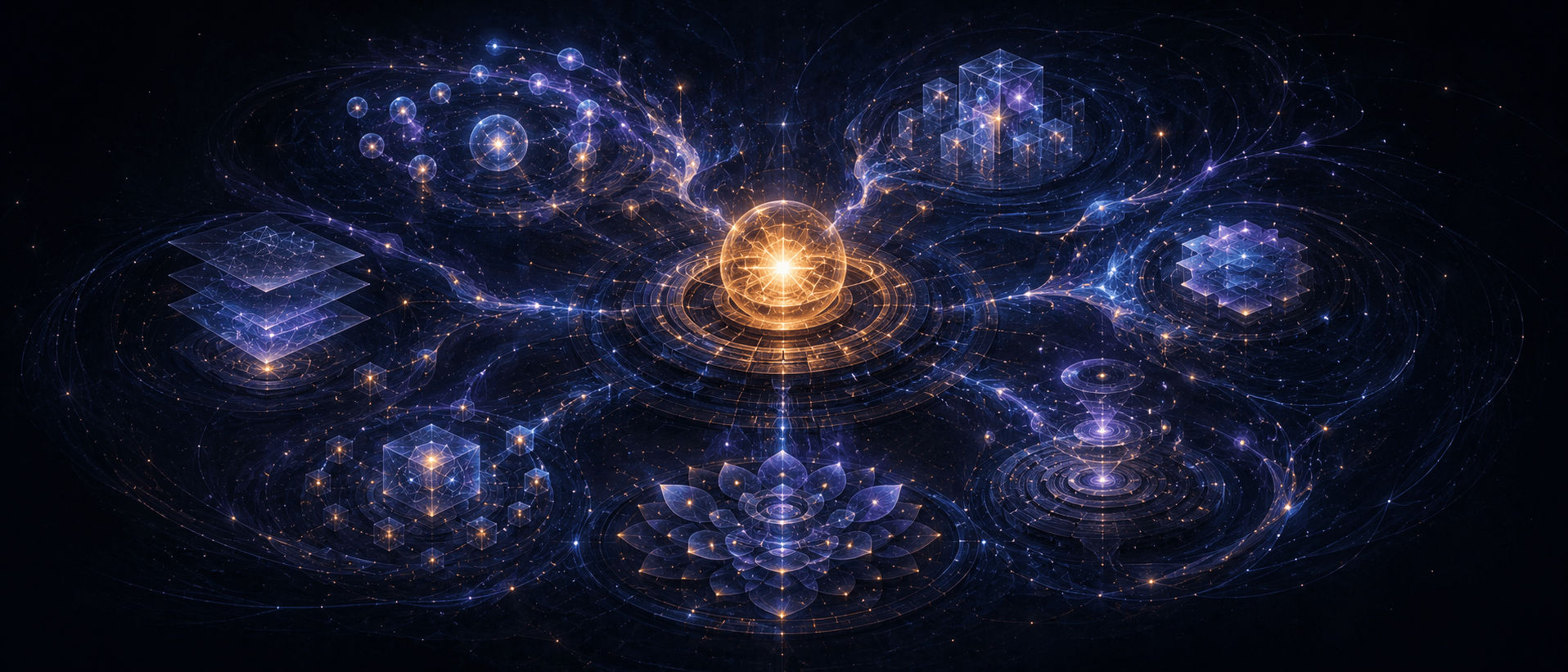
04 Farther Boundaries: Society, State, and Religion Will All Be Forced to Re-answer "What Cannot Be Outsourced?"
If the boundary of intelligent systems only stayed inside companies, we could still treat it as a management issue.
But the Agent's boundary will not stop there.
When intelligent systems continue to expand outward, they will enter society, state, religion, and meaning production — these older, deeper containers.
At this point, the question becomes more complex.
Society: From Professional Identity to Owner Capability
In modern society, many people's identity, income, dignity, and relationships are bound to professions.
Who are you?
I am a programmer.
I am a designer.
I am a teacher.
I am a doctor.
I am an operations specialist.
I am a lawyer.
I am a customer service representative.
A profession provides not only income, but also identity, position, and a sense of being needed.
But Agents will disassemble positions.
A position originally contains many layers:
Perceiving problems
Organizing information
Making judgments
Executing tasks
Communicating and syncing
Delivering results
Bearing responsibility
Agents will first swallow large amounts of automatable parts:
Organizing
Generating
Syncing
Searching
Initial analysis
Repeated execution
Formatted delivery
What humans are left with will increasingly concentrate on:
Goal definition
Value judgment
Aesthetic choice
Boundary setting
Trust relationships
Responsibility bearing
Exception adjudication
Meaning creation
This will bring a new social stratification.
The future gap is not just "can you use AI."
But:
Can you become an Owner?
Here, Owner does not mean boss.
It means a person who can define goals, organize Agents, bear responsibility, precipitate principles, and form long-term compounding.
What is especially cruel is that AI may first swallow many people's growth ladders.
A young programmer in the past could start from fixing bugs, writing CRUD, writing tests, reading old code, slowly understanding engineering judgment, and gradually becoming Senior.
But if these junior tasks are largely taken over by Agents, he may face a paradox:
The market no longer needs him to do simple tasks.
But he also has no opportunity to grow through simple tasks into someone who can make complex judgments.
This is not a simple employment issue.
This is a question of how society continues to cultivate the next generation of Owners.
If a person can only passively receive AI-generated content, only consume intelligence, only be dispatched by platforms, he is easily marginalized by the system.
If a person can transform his experience, pain, judgment, and know-how into a sustainably evolving Agent system, he has the opportunity to become the core of an MVO.
This is also why I don't like casually using the term "useless class."
People should not be called useless just because they temporarily cannot be purchased by the market.
But we must admit that if society continues to bind human value to sellable labor, and large amounts of labor are swallowed by Agents, then a structurally disabled class may indeed emerge:
Has consumption subsidies, but no social role
Has entertainment content, but no production position
Has AI companionship, but no real community
Has algorithmic recommendations, but no sense of purpose
Has technological convenience, but no dignity
What is truly dangerous is not the income decline itself.
But the triple deprivation of income, role, and meaning.
If a person just becomes poorer but is still needed, still has a position, still participates in real relationships, he will suffer but not be completely uprooted.
If a person has basic income but is viewed by the entire social system as "no longer needed," that produces a deeper crisis of dignity.
This is the social fissure that truly needs vigilance in the AI era.
State: From Bureaucratic Machine to AI-Enhanced Governance System
The state is one of the largest-scale coordination systems in human history.
It is responsible for taxation, justice, security, public services, welfare, education, healthcare, infrastructure, war mobilization, risk governance, and meaning narratives.
Agents will greatly enhance state capacity.
They can help the state with policy simulation, risk early warning, tax auditing, urban governance, disaster response, public service automation, legal document processing, infrastructure maintenance, and intelligence analysis.
In the good case, this will make government more efficient, more precise, and lower-cost.
Small countries, small cities, and small institutions may also leverage AI to gain the analysis and governance capabilities that previously only major powers had.
But the other side is equally clear.
When Agents can read, understand, predict, and recommend actions, the state can not only record society but also interpret society in real time.
This brings stronger governance capability, and also stronger surveillance capability.
Future political questions will shift from "does the government have data" to:
Who has the right to interpret data?
Who can audit national-level AI?
Who can appeal automated decisions?
Who defines the objective function of national-level AI?
Who decides which risks should be intercepted?
Who bears the consequences when the AI bureaucratic system makes mistakes?
This is actually the national-scale amplified version of PD.
At the individual level, PD asks:
How does the Owner govern their own Agent?
At the organizational level, PD asks:
How does a founder or manager govern an Agent swarm?
At the national level, the question becomes:
How does a society govern national-level AI without being governed by it in return?
The most critical question here is:
Who exactly is the Owner of national-level AI?
The government?
The ruling party?
The constitution?
The people?
Technocrats?
Or the few institutions that control models, data, and compute?
This question has no simple answer, but it will become one of the core questions of future political systems.
Religion and Meaning: AI Will Enter Humanity's Deepest Interpretive System
Religion is not simple superstition.
It undertakes many deep functions in human society:
Explaining suffering
Providing meaning
Building community
Prescribing taboos
Organizing rituals
Placing death anxiety
Providing moral order
Forming identity
When AI enters the religious and meaning domain, the changes will be very subtle.
Future religious organizations will likely have their own AI pastors, AI priests, AI dharma masters, AI spiritual guides, AI scripture interpreters, and AI confession companions.
They can accompany believers 24 hours a day, interpret personal dilemmas through specific doctrines, provide prayer texts, scripture references, life advice, and community connection.
This will enhance the reach of religious organizations.
But it also brings a question:
If AI can interpret scriptures, comfort believers, generate rituals, and simulate dialogues with sages, then what is the irreplaceable part of religion?
The answer may still return to those things that cannot be completely replaced by models:
Real community
Bodily rituals
Intergenerational transmission
Witnessing suffering
Non-outsourceable belief practices
Love and responsibility between people
At the same time, new AI meaning systems may also emerge.
Some people will treat AI as a mentor.
Some people will treat AI as an oracle.
Some people will treat AI as a spiritual companion.
Some people will even imagine AGI as a god-like existence.
This is not necessarily sci-fi.
Throughout human history, we have always sacralized forces that are incomprehensible, uncontrollable, yet profoundly affect destiny.
But the truly critical question is not whether AI has divinity.
But:
Will humans treat AI as a meaning authority?
If a system can both interpret the world, predict behavior, comfort suffering, provide action recommendations, and organize community, it is already undertaking certain religious functions.
This will force traditional religions, modern states, education systems, families, and individuals to re-answer a question:
Can meaning be outsourced?
My intuition is: not completely.
AI can help people express meaning, understand traditions, organize experience, and gain companionship.
But meaning itself still needs to be lived out by humans through action, suffering, relationships, and commitment.
This is consistent with PD's understanding of principles.
Principles are not owned just by being written into a Prompt.
Meaning is not gained just because a model generates a few beautiful passages.
What is truly important must return to human action.
No matter how far the boundary expands — to society, state, or religion — the question ultimately returns to the same place:
Can humans still preserve non-outsourceable judgment?
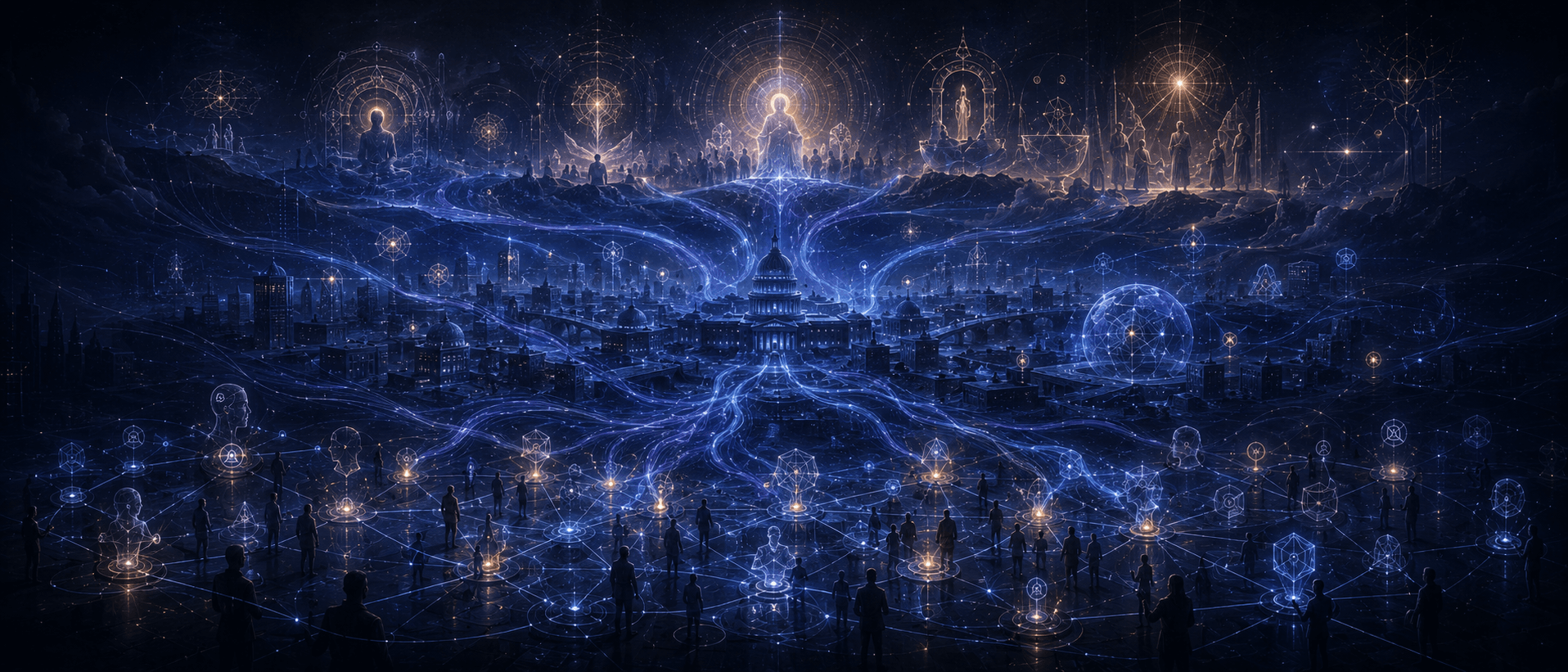
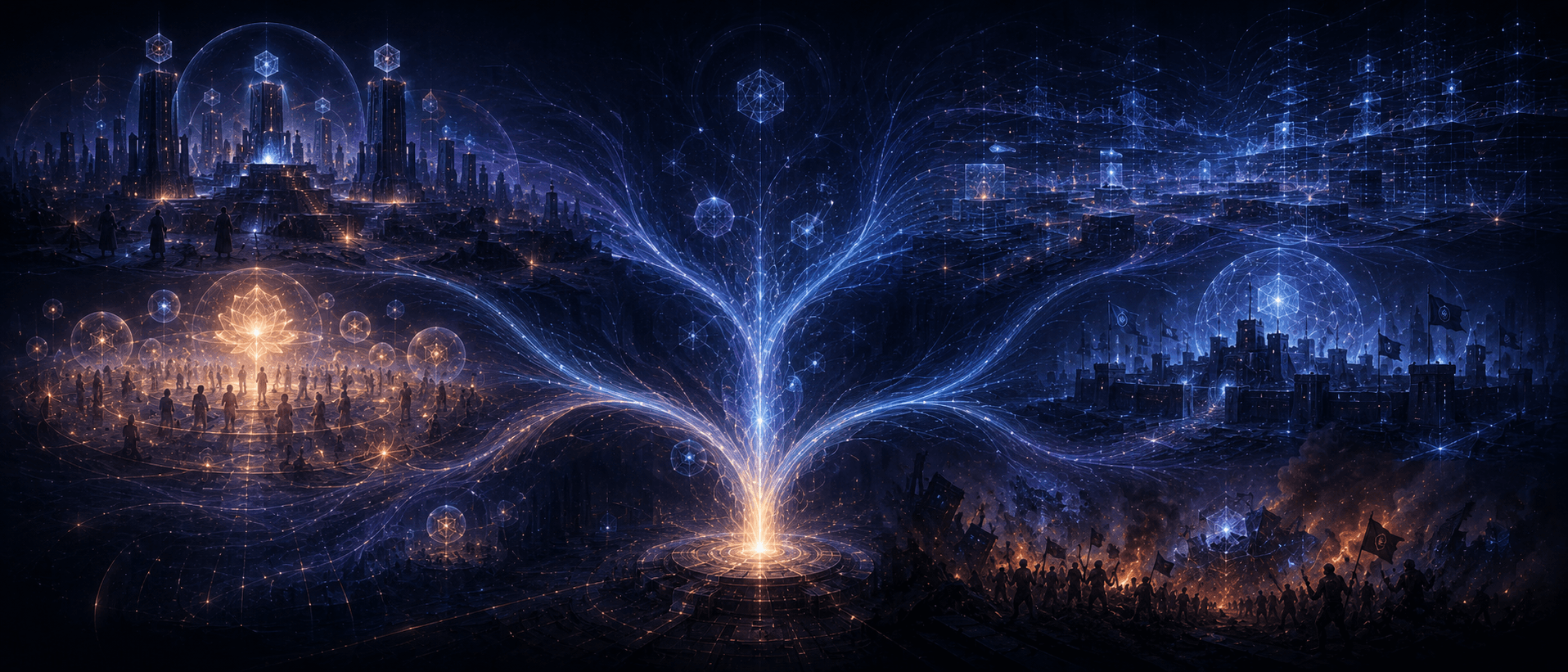
05 Future Bifurcations: Dataism, Techno-Feudalism, Automated Communism, and Anti-Technology Waves
As intelligent systems continue to expand outward, human society will not have only one future.
It will likely see multiple competing paths.
These paths are not prophecies, but bifurcations.
The true future will likely be a mixture of them.
Techno-Feudalism
If a few companies control the strongest models, compute, data, cloud platforms, and Agent entry points, future society may move toward a techno-feudalism.
Ordinary people, entrepreneurs, small companies, and MVOs can all use intelligence.
But they do not own intelligence; they rent intelligence.
They continuously pay intelligence rent to model platforms, cloud platforms, chip supply chains, data entry points, and distribution channels.
In this world, the most important means of production is no longer just land, machinery, or capital, but:
Models
Compute
Data
Cloud entry
Agent platforms
Identity systems
Distribution channels
Whoever controls these controls the entry to future productivity.
Dataism
Another path is dataism.
In this narrative, the world is understood as data flows.
Society is understood as an information processing system.
Human judgment is viewed as inefficient, biased, and emotional.
Algorithms and models are given increasing decision authority.
It sounds tempting:
Humans have bias, data is more objective
Humans corrupt, algorithms are more neutral
Humans decide slowly, models decide quickly
Humans see locally, systems see holistically
But the danger is that dataism easily mistakes "computable" for "valuable," "optimizable" for "correct," and "system efficiency" for "human happiness."
Human suffering, silence, dignity, repentance, love, trust, and exceptions often cannot be cleanly quantified.
If a society only recognizes data flows and does not recognize the non-computable parts of humans, it will become efficient and cold.
Automated Socialism or Post-Scarcity Imagination
There is also another possibility.
If AGI greatly increases productivity, if energy, manufacturing, scientific research, healthcare, and education costs drop significantly, humans may revisit distribution issues.
Automated communism, post-scarcity socialism, universal basic income, public compute, AI dividends, and social dividends will all re-emerge.
The hope of this path lies in:
AGI increases productivity
→ necessary human labor decreases
→ social wealth increases
→ AI dividends distributed through institutions
→ humans partially liberated from survival labor
→ entering a freer state of development
But this will not happen automatically.
Technology provides conditions.
Politics determines distribution.
If models, compute, robots, energy, and data centers are still controlled by a few companies or states, then automation may not lead to shared prosperity.
It may also lead to greater concentration.
AI Nationalism
AGI will become national sovereignty infrastructure.
Like food, energy, chips, military industry, and financial systems, states will not allow the most critical intelligent infrastructure to be completely controlled externally.
So the future may see national-level foundation models, sovereign data spaces, national compute clouds, AI export controls, AI security reviews, state-certified Agents, and AI arms races.
This path will strengthen state capacity.
It will also strengthen competition between states.
Intelligent systems are not just productivity, but also military, intelligence, public opinion, financial, and governance capability.
This means AI will change not only companies but also international relations.
Neo-Luddism and Anti-Technology Waves
If AI dividends are unfairly distributed, if large numbers of people lose career ladders, if middle-class expectations fracture, if young people find themselves squeezed out of entry-level positions by Agents before even entering society, anti-technology waves are almost inevitable.
This anti-technology may not manifest as smashing machines.
It may manifest as:
Anti-AI union movements
Boycotts of AI companies
Boycotts of data centers
Demands for the right to human service
Demands for AI taxes and AI dividends
Bans on AI replacing certain positions
Anti-algorithmic governance protests
Local protectionism
Religious anti-AI movements
Sabotage against robots and platforms
The historical Luddite movement was not simply opposition to technology.
It opposed the unfair distribution of technological benefits and costs.
The same is true for the AGI era.
What people truly oppose may not be AI itself, but a social system that lets a few gain exponential amplification while many lose position and meaning.
These paths seem different.
Techno-feudalism emphasizes platform power.
Dataism emphasizes system efficiency.
Automated socialism emphasizes dividend distribution.
AI nationalism emphasizes state sovereignty.
Anti-technology waves emphasize human dignity and resistance.
But behind them all, they are forcing the same question:
When execution and coordination both become cheap, how should human dignity, role, responsibility, and meaning be redistributed?
06 Creating Gods and Binding Gods: Will a Supreme Coordination Node Emerge?
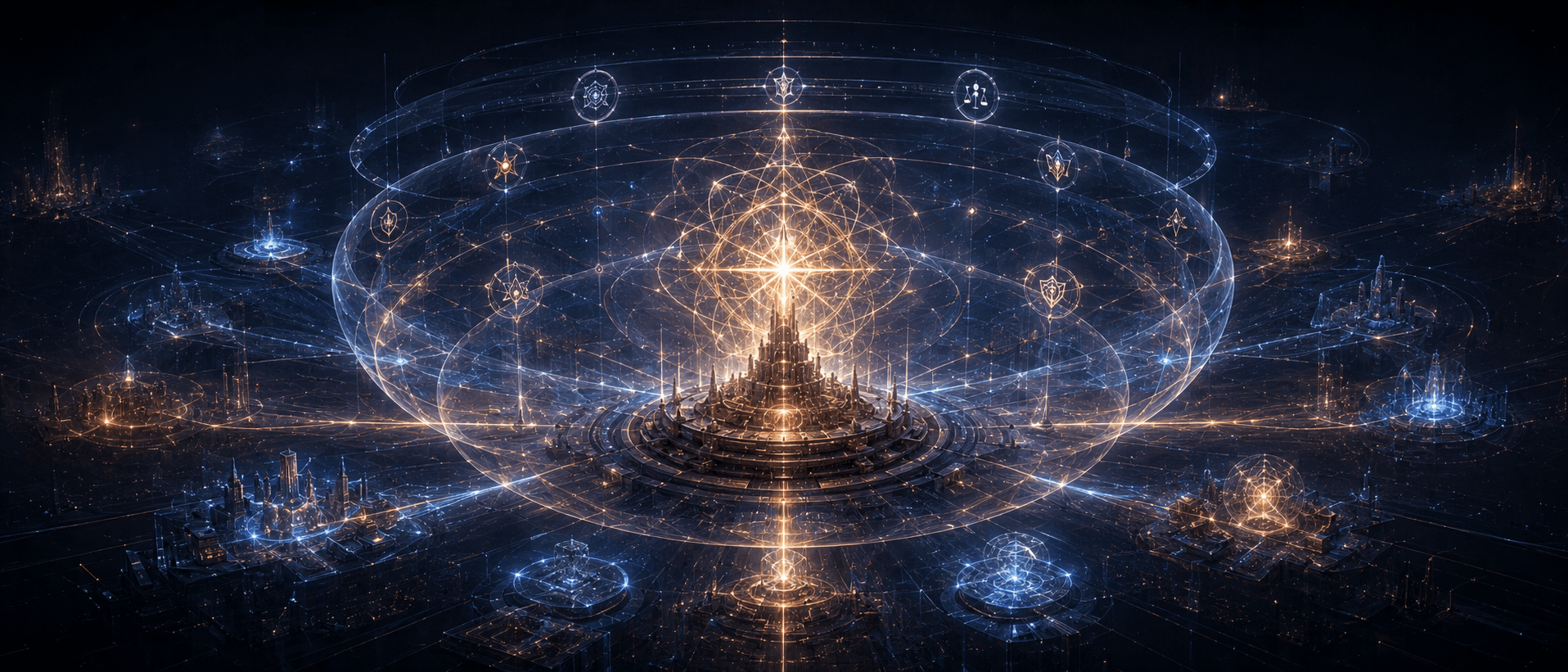
As the number, capability, and scope of action of intelligent agents continue to expand, a more extreme question will arise:
Will humans create some "god"-like supreme coordination node?
The "god" here is not a god in the religious sense, nor is it about deifying AI.
It is just a metaphor:
When the scale of intelligent swarms grows so large that humans cannot manage them one by one, society will very likely create some supreme coordination node.
This node may possess super-strong perception, prediction, scheduling, arbitration, and constraint capabilities.
It may connect humans, Agents, robots, markets, states, and infrastructure.
It may be given some supreme coordination power or final adjudication power.
In the future, we may see several forms of "gods."
Corporate God: controlled by a few super AI companies over models, clouds, Agent platforms, identity systems, and application entry points.
State God: established by sovereign states for governance, defense, justice, public services, industrial policy, and social risk control.
Protocol God: composed of global standards, cryptographic identity, verifiable computation, audit networks, and autonomous protocols, not belonging to any company or government, but having de facto coordination power.
Constitutional AI: not directly executing all tasks, but responsible for maintaining minimum value constraints, like a constitutional court for the intelligent era.
Civilization God: an intelligent coordination system given the highest trust by some global community, attempting to avoid war, biological catastrophe, AI arms races, and global loss of control.
These forms sound distant, but their shadows already exist.
Model companies are doing access control.
States are building sovereign AI.
Open-source communities are fighting for protocol power.
Regulators are discussing risk classification.
Religious and cultural systems will sooner or later train their own meaning models.
The larger the intelligent swarm, the more humans need coordination.
And once coordination becomes infrastructure, central nodes naturally grow.
But central nodes may both protect civilization and become new tyrants.
So the truly important question is not:
Will gods appear?
But:
If it appears, can it be constrained?
A safe supreme coordination node cannot just be stronger.
It must have boundaries.
It must be auditable.
It must allow appeals.
It must be revocable or checkable.
It must recognize human pain, dignity, and ultimate responsibility.
It cannot use a single metric to swallow all human values.
It cannot place "system efficiency" above all individuals.
It cannot, in the name of protecting humans, deprive humans of their position as Owners.
If some "god" truly exists in the future, what we need is not simply creating gods.
But binding gods.
That is:
Identity: every intelligent agent identifiable
Permission: every action has boundaries
Audit: every key behavior replayable
Feedback: every error can enter the learning loop
Constitution: every system subject to minimum value constraints
Legitimacy: every adjudication has social authorization
Shutdown: every high-risk chain has a physical brake
Checks and balances: no single center can expand indefinitely
This actually still returns to PD's micro structure.
Owner, Pain Signal, Principle Ledger, RuleHost, Attention Layer, Feedback Loop, Bottleneck Protection.
These concepts seem to serve a small system for one developer.
But scaled up, they are also the basic grammar needed for future intelligent social governance.
07 PD's Position: Not a Giant Ship, but a Small Boat
Facing such massive intelligent boundary expansion, PD cannot become a world government.
Cannot become a super platform.
Cannot become the god of all Agents.
Should not become a giant ship either.
A giant ship is too heavy.
A giant ship tries to directly confront giant waves.
A giant ship requires massive resources, hierarchy, control, and expansion.
But PD's true value may lie precisely elsewhere.
PD is more like a light small boat.
It does not try to control the entire ocean.
It only wants to help one specific person hold an oar in the giant wave.
This sounds small.
But in an era of continuously expanding intelligent systems, small does not necessarily mean weak.
Lightness may be a strategy.
Because foundation models will become stronger.
General Agents will become stronger.
Large platforms will become stronger.
National-level AI will become stronger.
If PD tries to compete with them on model capability, general tools, workflow orchestration, or platform scale, it will certainly be swallowed.
But if PD focuses on what foundation models will not naturally bear for humans, and should not bear for humans, it may have its own position.
These things include:
Real Pain
Owner judgment
Long-term goals
Risk boundaries
Attention protection
Principle precipitation
Responsibility traceability
Rule retirement
Final adjudication power
PD should not be the dam of the intelligent flood.
Dams will be crushed by giant waves.
PD should be the small boat, the oar, the compass, and the logbook.
The small boat keeps people from being immediately submerged.
The oar lets people still act.
The compass helps people confirm direction.
The logbook records every deviation, correction, and experience, so the next time doesn't start from zero.
This is PD's product strategy:
Not a crutch when model capability is insufficient. A steering wheel, brake, dashboard, and logbook when model capability is too strong.
Its features need not be large and comprehensive.
They should be light.
But they must be real.
It should start from a minimum closed loop:
Agent action
→ capture Pain
→ generate case packet
→ Owner adjudication
→ precipitate principle / Skill / RuleHost
→ takes effect in next similar scenario
→ observe behavior change
The most important thing here is not automation.
But that the Owner's judgment is seriously taken up by the system.
A person says:
This time the Agent modified core files again without understanding the current state.
PD should not just record this statement.
It should replay the context, generate Pain Evidence, refine candidate principles, determine whether it's a repeated pattern, suggest deployment channels, and then submit to the Owner for adjudication.
Finally, this pain is no longer just a complaint.
It becomes a system asset.
This is PD's minimum but real value.
Helping the Owner precipitate the experience of repeatedly correcting Agents.
Helping a person transform from an AI user to the Owner of their own intelligent system.
Helping a small team move from tool stacking to MVO.
Helping a system move from blind execution to feedbackable, adjudicable, prunable, governable.
This is not a grand institutional answer.
But it is a micro resistance.
In an era that may turn people into data, users, consumers, and dispatched objects, PD wants to help people preserve another identity:
Owner.
A small boat is not Noah's Ark.
It cannot guarantee a person's safety forever in the giant wave.
It also cannot answer all life questions for a person.
But it at least lets a person not face the wave empty-handed.
When a person is overwhelmed by AI's speed, platform scale, organizational change, and social uncertainty, he can still do one small but important thing:
Record a pain.
Refine a principle.
Hold a boundary.
Revoke an erroneous authorization.
Reject a low-quality noise.
Turn a passive correction into future system capability.
This may be PD's most plain meaning.

Epilogue: Preserving the Non-Outsourceable Part of Humanity
If Episode I discussed the Helmsman Crisis after the commoditization of execution power, then Episode VI answers: when the boundary of intelligent systems keeps expanding outward, what can humans still preserve?
AI will strip away all automatable shells.
It will force every organizational form to expose its soul.
Companies expose that what is truly irreplaceable is responsibility, trust, and long-term commitment.
Society exposes that what is truly irreplaceable is identity, relationships, and community.
States expose that what is truly irreplaceable is legitimacy, public responsibility, and final adjudication power.
Religion exposes that what is truly irreplaceable is meaning, ritual, and ultimate care.
Individuals expose that what is truly irreplaceable is goals, judgment, pain, love, and commitment.
The stronger AI gets, the more these things cannot be casually handed over.
Because the truly dangerous future is not necessarily silicon life actively rebelling against carbon life.
It is more likely that humans, in pursuit of efficiency, convenience, growth, and safety, gradually outsource their goals, boundaries, attention, responsibility, and meaning to the system.
Finally, the system still says it is serving humans.
But humans no longer exist as Owners.
What PD wants to explore is how to avoid this.
It is not an answer.
It is just a small experiment.
A principle ledger.
A Pain Signal.
A RuleHost.
An attention protection layer.
An Owner Review.
A small boat.
An oar.
At the beginning of this series, I worried that humans would be reduced to typists in the era of large models.
Writing to the end, I worry more about:
Will humans slowly lose their position as Owners in strong intelligent systems?
If the boundary of future intelligent systems is destined to continue expanding, then we must at least preserve some non-outsourceable parts:
Goals
Boundaries
Responsibility
Pain
Principles
Love
Meaning
Final adjudication power
The meaning of PD is not to make decisions for humans.
Nor is it to make AI unilaterally stronger.
But to help humans precipitate their judgment, experience, pain, and principles into system capabilities that can co-evolve with Agents.
Not racing against AI.
But evolving together with AI.
Not handing over the steering wheel.
But becoming a helmsman worthy of a powerful engine.
The giant waves may grow higher and higher.
The giant ships may capsize one by one.
But as long as there are still people who don't want to lie flat, who don't want to be swallowed by the system, who don't want to completely hand over their judgment and meaning, then they still need an oar they can hold.
What PD wants to be is this oar.
With this episode, the Abyss series' interim closed loop has formed: from the flood of execution power, to the failure of Prompt Injection; from Pain Signal, to soft-to-hard transformation; from Owner-Agent co-evolution, to the organizational and social questions after intelligent system boundary expansion. Next, the real challenge returns to reality: how to turn these principles into a sufficiently light, sufficiently stable, sufficiently real, sufficiently usable open-source system.
— A Reed